Nigel Bruce

Nigel Bruce
  • Date of birth: 1895
  • The date of death: 1953
  • Profession: Actor, Soundtrack, Archive_footage
Nigel was, from the beginning, typecast as bumbling English aristocrats, military types or drawing room society snobs and, within the narrow parameters of his range, he was very, very good at playing these parts. Nigel Bruce was born in Mexico, where his father, Sir William W. Bruce, worked as an engineer. His family was part of English aristocracy, ever since Charles I. bestowed a baronetcy upon them in 1629 (William's older brother Michael held the hereditary title). Nigel was educated in England at Grange, Stevenage and Abingdon. His first job was at a stockbroker's firm. During World War I, he served in the British Army (like his future co-star, Basil Rathbone) where he received a serious leg wound and was for some time confined to a wheelchair.

Following his discharge, he turned to acting in 1919, but it wasn't until ten years later that he achieved a breakthrough in Noël Coward's 'This was a Man' on Broadway. Then followed the performance which was to set the standard for all his later work in Hollywood: the 1931 comedy "Springtime for Henry". On the strength of his performance as Johnny Jelliwell, Fox offered Nigel the opportunity to reprise his role in the 1934 movie. Soon after that, Nigel was cast to star as British detective Bertram Lynch in a minor thriller, Murder in Trinidad (1934). The contemporary New York Times Review (May 16,1934) was skeptical about the film's merit, but found Nigel's performance 'compelling'. After that followed a gallery of endearingly stereotypical 'Britishers': Squire Trelawny in Robert Louis Stevenson's classic Die Schatzinsel (1934), the Prince of Wales in Die scharlachrote Blume (1934), Professor Holly in Herrscherin einer versunkenen Welt (1935) and Sir Benjamin Warrenton in Der Verrat des Surat Khan (1936). All, without exception, were roles in which Nigel felt perfectly at home.

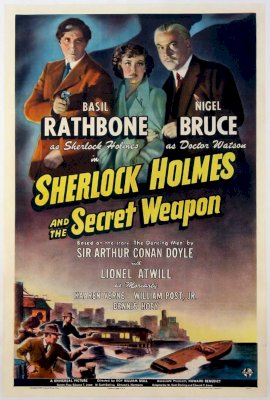
In 1939, he teamed up with Basil Rathbone for the first two Holmes/Watson movies, Der Hund von Baskerville (1939) and Die Abenteuer des Sherlock Holmes (1939), filmed at 20th Century Fox. Both films had an authentic period feel for Victorian England and the chemistry between the two stars was just right. Three years later, Rathbone was contractually obliged to make a further series of twelve Holmes pictures at Universal, again co-starring Nigel as Dr. Watson. Nigel portrayed his lovable self in two Hitchcock classics Rebecca (1940) (as Major Giles Lacy) and Verdacht (1941) (as 'Beaky').

A prominent member of the resident English colony in Hollywood, Nigel Bruce at one time captained the cricket club established by fellow actor and compatriot C. Aubrey Smith in 1932 (other members included P.G. Wodehouse, Boris Karloff, Ronald Colman and David Niven).

The best films