A regular "good guy" and "bad guy" presence in sagebrush sagas and
two-fisted film action during the early 1950s, brawny, blond-haired
Alexander Livingston Nicol Jr. was born in 1916 in Ossining, New York,
the son of a prison warden there at Sing Sing, and his wife, the matron
of a detention center. Alex developed an early interest in acting and
originally trained at the Fagin School of Dramatic Art.
On the professional stage from 1938, he soon found work as an
apprentice to Maurice Evans. As
part of the ensemble in his highly-regarded Shakespearean production
company, he appeared on stage with the great actor in "Henry IV, Part
I" (1939) and "Richard II" (1940) on Broadway. Following a stage role
in "Return Engagement," his newly-found career was interrupted by World
War II. Following his five-year stretch as a Tech Sergeant with the
National Guard and Cavalry Unit, he became a student and eventual
charter member of Lee Strasberg's Actors
Studio. He also returned to Broadway in such shows as "Sundown Beach"
and "South Pacific" (in the ensemble as a Marine). Other post-war stage
plays included "Waiting for Lefty," "Forward the Heart" and "Mister
Roberts," in which he took over
Ralph Meeker's role (as the sailor Minnion)
and served as understudy to Henry Fonda. The
pinnacle of his Broadway career occurred when he replaced
Ben Gazzara and received excellent reviews
as Brick in "Cat on a Hot Tin Roof" in 1956.
Alex's film career was launched when he was discovered by
Universal-International director
George Sherman, who cast him in a
prime role in his film mystery
The Sleeping City (1950)
starring Richard Conte and
Coleen Gray. He next appeared in
Tomahawk - Aufstand der Sioux (1951), the first of his many
oaters, which starred Yvonne De Carlo,
Van Heflin and an up-and-coming
Rock Hudson. Continuing in the same vein
throughout the early 1950s as both support player and occasional lead,
he played an assortment of decent, law-abiding sheriffs and simpering,
murdering gunslingers in such westerns as
Feuerkopf von Wyoming (1953),
his first co-starring role opposite
Maureen O'Hara,
Auf verlorenem Posten (1953),
Die Hand am Colt (1953),
Duell in Sokorro (1954), and his
best film,
Der Mann aus Laramie (1955)
in which he memorably menaced
James Stewart. Outside the western
genre he rolled out such outdoor/war pictures as
Target Unknown (1951),
Air Cadet (1951),
Unternehmen Rote Teufel (1952) and
In geheimer Kommandosache (1955),
the last mentioned also starring Stewart. He also top-lined a few
British-made pictures during this 1950s time period.
Television also brought Alex work with a number of appearances in such
popular shows as "The Twilight Zone," "Dr. Kildare" and "The Outer
Limits," among others. Unable to break free of his rugged secondary
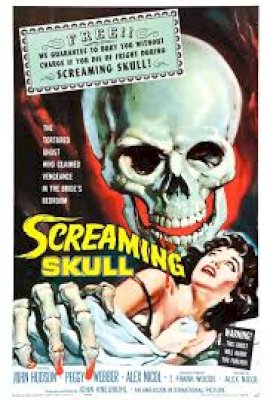
typecast, he also tried his hand at directing, his first being the
semi-cult horror film
Der schreiende Schädel (1958) in
which he was a secondary character in a cast of five. He found more
prolific directing offers on TV, notably the "Tarzan" series starring
Ron Ely throughout the 1960s.
In 1959, after receiving a major part in the Italian/Yugoslavian
picture Jovanka und die Anderen (1960),
Alex and his family transported themselves to Rome for a couple of
years where he continued to film. Although they returned to the US in
1961, he would often show up in a European-made "spaghetti western" or
two during the early 1960s. He appeared sporadically on TV and film
into the next decade, his last feature being the extremely low-budget
giant monster flick A*P*E (1976), about a 36
foot gorilla that terrorizes Korea, a film he agreed to do for his
friend Paul Leder. Alex retired fully in 1987
and died in Montecito, California in 2001 at the age of 85, survived by
long-time wife (since 1948), former actress Jean Fleming, and their
three children (two sons and a daughter).