In the 1930s, 1940s, and especially the 1950s, if a director
wanted a short, fat actor to play a windy storekeeper or a raucous
conventioneer, he might well cast Dick Elliott. He was one of those
actors who, whenever he appeared on screen, often for less than a
minute, the audience would think, "Oh, it's that guy." Yet few would
ever know his name.
Elliott was certainly short, probably not much more than five foot
four. And he was certainly fat. His belly was large and round, so he
looked a bit like a huge ball with arms and legs. One imagined him soft
and pink, and always happy. A Hobbit, perhaps. Santa Claus without the
whiskers. And like another short, fat actor, Eugene Pallette, Elliott
had a distinctive voice. Not the bullfrog basso that rumbled out of
Pallette's gullet, but higher-pitched, whiny, or honey-smooth as the
role demanded, with an "sh" in place of a lot of "s" sounds.
Elliott appeared in over 240 films. He was most often cast as judges,
mayors, newspaper reporters, policemen, and blowhards, usually one who
can't stop talking except when he'd burst into a loud laugh that
bordered on a cackle.
As was the case with many character actors who never became featured
players, not much record remains of his personal life. He was born
Richard Damon Elliott on April 30, 1886, in Salem, Massachusetts. His
gravestone says he was a loving husband and father. And we know he
began performing in stock in 1931 and was on stage for nearly thirty
years before his film debut, including appearing in the long-running
hit, "Abie's Irish Rose." Other than that, we have only his film and
television appearances to go on, and I'll mention some highlights.
His first movie was Central Airport (1933), and he was Ned Buntline
in Annie Oakley (1935) with Barbara Stanwyck in 1935. He was perfect for the
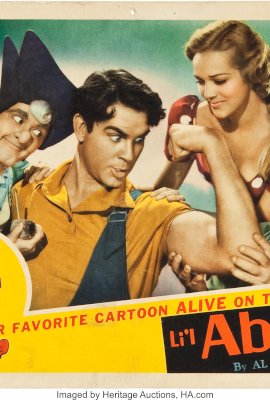
role of Marryin' Sam in Li'l Abner (1940), was amusing as the Judge
in Weihnachten nach Maß (1945), again starring Stanwyck, and made
the most of his small role as a Whiskey Drummer in Abenteuer im wilden Westen (1948) with Eddie Albert. Many film fans remember him best for another
small role, as the man on the porch in the holiday perennial Ist das Leben nicht schön? (1946), who tells James Stewart to stop jabbering and
go ahead and kiss Donna Reed. Often his role in a film was so small his
character didn't even have a name, and was sometimes listed in the cast
simply as "Fat Man." He did have a good part in the under appreciated
film Park Row - Eine Zeitung für New York (1952). His last film role was in Go, Johnny, Go! (1959).
The advent of television opened up a whole new world of roles. An
unending stream of weekly comedies, dramas, and even variety shows
needed performers. Some featured character actors like Gene Lockhart
and Cecil Kellaway might star in an episode of an anthology series.
Actors who had little screen time in films became invaluable featured
players, and a few even attained the Holy Grail of being a series
regular, Elliott among them. In the fifties he appeared in dozens and
dozens of TV shows, including Dick Tracy (1950), in which he had a
recurring role as Chief Murphy, My Little Margie (1952), Superman - Retter in der Not (1952), I Love Lucy (1951), I Married Joan (1952), in which his character was called "Fatso," December Bride (1954), and Tausend Meilen Staub (1959). One of his best roles was in
the episode The Rain Wagon (1955), in which he
played Osgood Falstaff, the Shakespeare-quoting rainmaker who is
secretly a bank robber. It was rare for Elliott to play a villain, but
he pulls it off, making his eyes look devious and sinister -- a cuddly
fat man, but don't turn your back on him. At the other extreme, he
often played Santa Claus on Christmas episodes of the Jimmy Durante,
Red Skelton, and Jack Benny shows.
To many people, Elliott will always be remembered as Mayor Pike in The Andy Griffith Show (1960) Sadly, Elliott died during the second season of
the show, on December 22, 1961, in Burbank, California.
Dick Elliott was one of those character actors who were almost
anonymous, though they lit up the screen in short roles. Fortunately,
because of "It's a Wonderful Life" every Christmas and "The Andy
Griffith Show" in frequent reruns, his fans can still delight in the
little fat man.