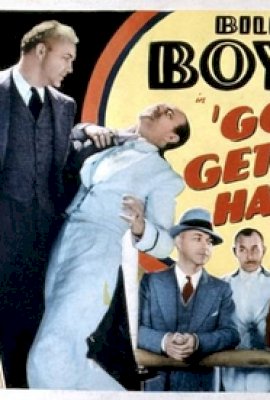
Legendary "B" picture director Sam Newfield was born Samuel Neufeld in
New York City. His brother was
Sigmund Neufeld, later the head of PRC
Pictures, where Sam made so many of his films (so many, in fact, that
he had to use the pseudonyms "Peter Stewart" and "Sherman Scott" so
audiences wouldn't notice that only one man directed so much of the
studio's output). He entered the film business in 1919 and began his
career as a director in 1926, shooting two-reel comedy shorts for
virtually every production company in town, from fly-by-night
independent producers to major studios like Universal Pictures. He made
his first full-length feature in 1933, for independent "B"-picture
production company Tower Pictures. He worked for many of the
independent studios, making films for such prestigious-sounding but
low-rent companies as Ambassador Pictures, Victory Pictures and Puritan
Pictures. While much of his output seemed to be, shall we say,
"rushed", he did in fact manage to turn out several interesting,
compact and well-made little westerns with
Tim McCoy for Victory and Puritan (two
companies headed by another "B" picture icon, producer
Sam Katzman).
In 1939 he went to work for PRC, where he would make his "name". Sam
shot films in two styles: fast and faster. With rock-bottom budgets (at
PRC, for instance, budgets were so low that he got paid only $500 a
picture; he had to grind them out like sausages in order to make any
kind of money), super-tight shooting schedules (often a week, sometimes
less) and not necessarily the best talent in front of and behind the
cameras, glitches were bound to happen. However, since Sam didn't
believe in retakes (and couldn't afford them, anyway), whatever went
wrong in the picture (crew members wandering into shots, actors
flubbing lines, props malfunctioning, etc.) pretty much stayed in the
picture. Sam made films in just about every conceivable genre
(science-fiction, westerns, crime thrillers, horror, comedy), and while
most were routine at best (and embarrassingly inept and/or incoherent
at worst), there were a few bright spots among the dross:
Lost Continent (1951), a sci-fi
epic he made for low-budget specialist Lippert Pictures in 1951, showed
more care than you normally found in a Newfield film, with a better
cast and a more coherent script than he was usually given, and is now
considered to be one of his best films, if not his best. He also turned
out
Jack der Killer (1950)
for Lippert, a fast-paced, neat little crime thriller about railroad
detectives investigating a string of murders.
Newfield is considered to be among the most prolific directors in the
history of American films (not counting cartoon directors, whose
product rarely ran longer than 8-10 minutes or so), with an output
estimated at approximately 300 films--everything from one-reel
black-and-white training films to full-length color features--over a
30-year-plus career. He spent the last few years of that career
shooting films and TV series outside the US (he shot the
Buster Crabbe action series
Captain Gallant of the Foreign Legion (1955)
in Morocco and the Lon Chaney Jr. western
series
Hawkeye and the Last of the Mohicans (1957)
in Canada) because of cheaper production costs.
Sam Newfield finally retired from the film industry in 1958 and died in
Los Angeles in 1964.